A while ago, listening to a podcast about mothers in Gaza, one detail stayed with me: the famine these women are living through will shape not only their own bodies, but also those of their unborn children. Trauma, hunger, and stress are carried forward into future generations. This is not new. During the Dutch Hunger Winter of the Second World War, a season of starvation left a measurable biological imprint on the daughters of pregnant women who lived through it. A reminder of how maternal experiences lived today ripple across time.
Motherhood holds a particular place in our collective imagination — and precisely because of that, it offers a powerful lens for thinking about futures. That’s why I was glad when Helene Mathiasen at Pej Gruppen invited me to write for TID & tendenser.
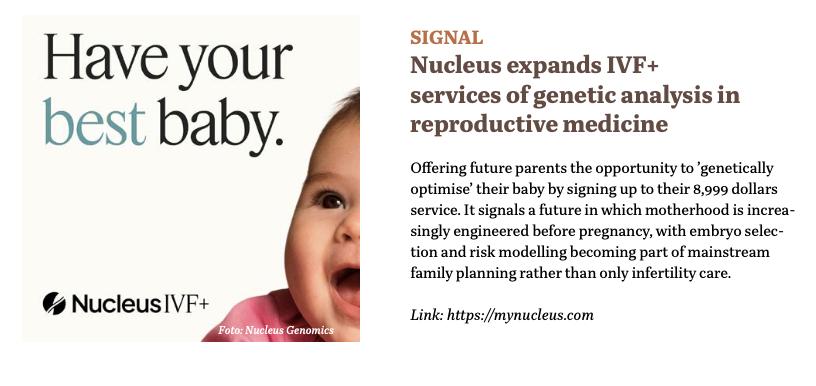
The article explores three futures of motherhood that are already taking shape. In a climate-volatile world, motherhood is increasingly defined by environmental risk. from climate doulas in Florida preparing pregnant women for hurricanes, to the presence of microplastics in human placentas. In a hyper-technological era, reproduction is becoming managed and optimised: synthetic wombs, algorithmic co-parenting tools and genetic enhancement packages are no longer science fiction. And in a collective, care-scarce world, motherhood is quietly decoupling from partnership, becoming more intentional, more shared and more infrastructural.
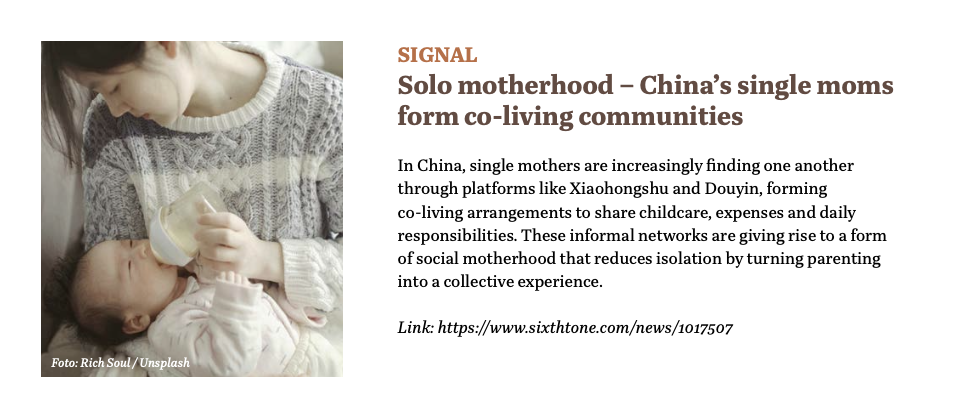
Across all three, the question is the same: what does it mean to bring a child into a world shaped by volatility, technology and shrinking care systems? Futures of motherhood are not only about parents and children. It is a lens on society itself — revealing how we understand vulnerability, responsibility and the kinds of futures we are willing to bring into being.
The full article is available for TID & tendenser members at https://tidogtendenser.dk/